Stanford University researchers today released their much-anticipated AI Index 2026 report, which reveals a world where artificial intelligence technologies are being adopted at a record pace, even as public trust in AI oversight and transparency plummets.
The report by the Stanford Institute for Human-Centered Artificial Intelligence, known as the Stanford HAI, is now in its ninth year. A comprehensive annual study that tracks the AI industry’s paradoxical evolution, it documents a world where America’s lead over Chinese innovation has evaporated, and where technology is already reshaping the world’s workforce and changing the way scientific discovery is made.
The race for world domination
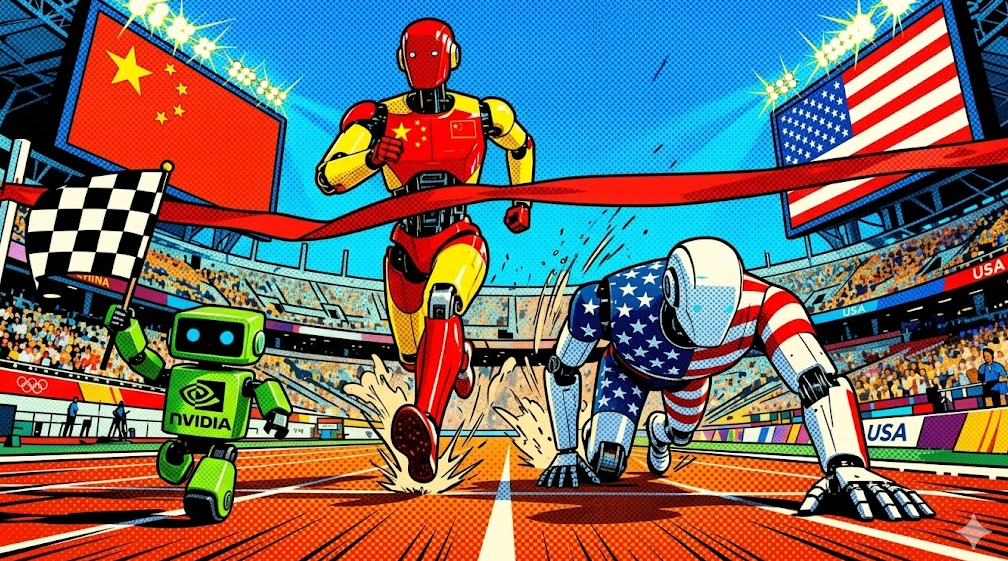
One of the most impressive – and potentially touching – takeaways from this year’s report is how China has reportedly closed the AI performance gap between itself and the US In last year’s reports, the US has been lagging behind Chinese innovators, but now the countries are neck and neck, with US and Chinese models consistently trading top spots for AI performance ratings.
While the US maintains a significant edge in terms of money, infrastructure and AI chips, China is now gaining ground in other key areas, such as patents, publishing and the development of autonomous robots, also known as “physical AI.”
However, the report notes that it is no longer a two-horse race, with other nations also vying to be seen as “AI superpowers.” This includes South Korea, which has emerged as a world leader in terms of “innovation density,” filing more patents per capita than any other country.
As these countries all seek AI supremacy, the issue of “sovereignty” has become a policy priority for many governments. A number of countries in Europe and Central Asia invested heavily in their AI infrastructure last year, bringing the number of nations with “large government-backed clusters” to 44.
However, the AI push for royalty isn’t all there is to it. Countries in South America and the Middle East are far behind. According to Stanford researchers, this could lead to a new type of “digital divide,” where those nations struggling to adapt to AI development are less likely to see economic benefits.
Increasing corporate influence as transparency deteriorates
More than 90% of all notable AI models have been created by private companies, and Stanford researchers warn that this leads to less transparency than ever before. Concerns about AI “black boxes” are nothing new, but the new, more powerful models being released today are more mysterious than ever.
According to the report, AI leaders including Google LLC, Anthropic PBC and OpenAI Group PBC have all stopped the practice of disclosing their model’s latest dataset sizes and training durations. In addition, 80 of the 95 most notable models launched last year were released without their training code.
Meanwhile, these leading AI companies are now trying to flex their political muscle. AI industry representatives have become ubiquitous in AI conference proceedings, with their share of witnesses tripling since 2017, while the presence of neutral academics has declined.
This change, perhaps unsurprisingly, comes at a time when public trust in AI is at an all-time low. The report found that only 31% of US citizens trust their government to regulate AI properly, which was the lowest of all countries surveyed outside of China, where only 27% of people trust their government. EU citizens remain very confident, with 53% of people expressing confidence.
There are also concerns about hardware supply chains, with almost the entire global AI industry still dependent on a single chipmaking facility operated by Taiwan Semiconductor Manufacturing Co. in Taiwan.
Discovery is booming, but conflict is raging
Adoption of generative AI has grown faster than any other technology in history, the report found. About 53% of the world’s population now uses it regularly, outpacing innovations such as personal computers, the Internet and smartphones. But opinions of the technology are mixed, with 59% saying it offers more benefits than drawbacks, and 52% saying it makes them nervous.
Worrying, perhaps, is that while the US is leading the way in AI development, it ranks only 24th globally in terms of adoption, with only 28.3% of Americans using AI for productivity regularly. That compares to China, Malaysia, Thailand, Indonesia and Singapore, where more than 80% of people expect AI to have a major impact on their lives within the next three to five years.
The economic impact of AI is also impressive: Since 2013, corporate investment has increased 40-fold, while consumer surplus related to generative AI in the US has risen to $172 billion this year.
Another highlight of the report is the growing “vibe shift” between professionals and the general public. While 73% of AI experts are optimistic about the technology’s impact on jobs, only 23% of the public shares that belief. However, the skepticism of average citizens seems to be justified, as the report notes that the employment of young workers in “areas exposed to AI” has started to decline.
In addition, the report touches on the tangible costs of AI’s dramatic growth. The industry’s demands for energy and water are becoming alarmingly extreme. For example, xAI Corp. it is estimated to have created more than 72,000 tons of CO2 just to train its latest model, the Grok 4. Meanwhile, the amount of water required for the GPT-4o’s workload is said to be enough to support 12 million people.
Finally, there are concerns about the impact of AI on science, especially regarding its scope. Although AI tools have helped make individual scientists more productive, this appears to be due to the scope of AI research, which is more interested in data-rich topics, meaning less diversity than before.
Photo: SiliconANGLE/Gemini
Support our mission to keep content open and free by engaging with the CUBE community. Join CUBE’s Alumni Trust Networkwhere technology leaders connect, share wisdom and create opportunities.
- 15M+ viewers of CUBE videosenabling conversations across AI, cloud, cybersecurity and more
- 11.4k+ CUBE alumni – Connect with more than 11,400 technology and business leaders who are shaping the future through a unique network based on trust.
About SiliconANGLE Media
Founded by technology visionaries John Furrier and Dave Vellante, SiliconANGLE Media has built a dynamic ecosystem of industry-leading digital media products that reach 15+ million elite technology professionals. Our new ownership of CUBE AI Video Cloud is starting to engage with audiences, using CUBEai.com’s neural network to help technology companies make data-driven decisions and stay at the forefront of industry conversations.