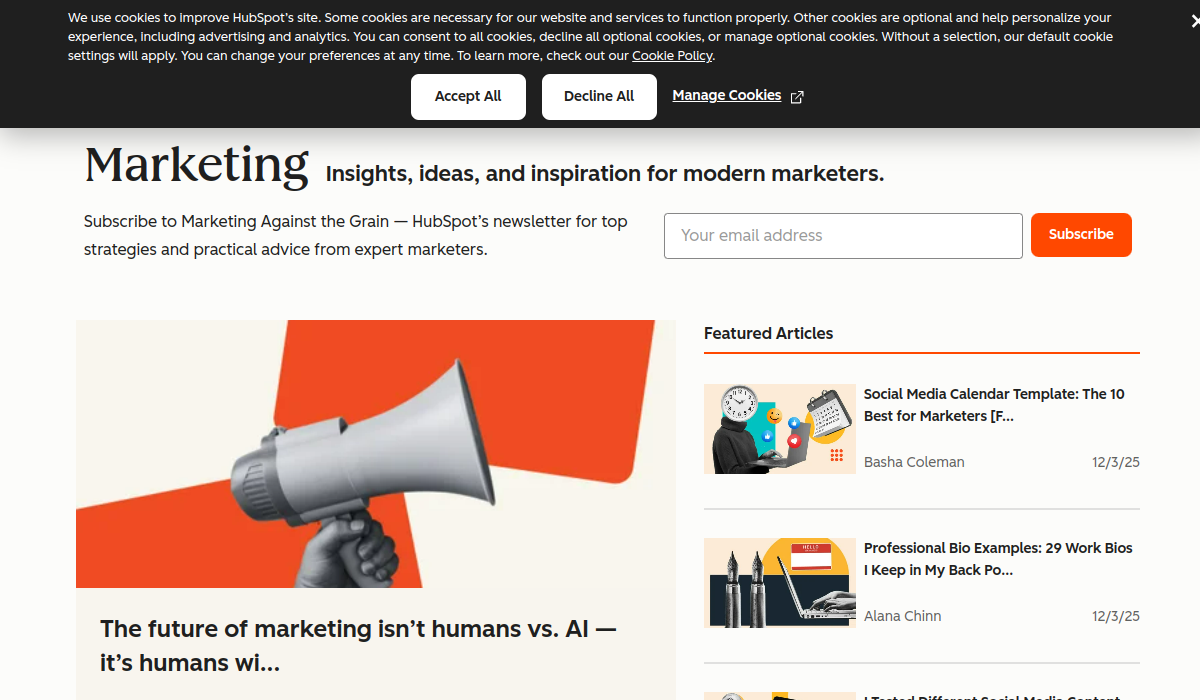
In 2006, two MIT students founded a small marketing software company with a strong idea: instead of distracting people with ads, how about engaging them with genuinely useful content? Two decades later, HubSpot is worth more than $35 billion, serves more than 228,000 customers in 135 countries, and is synonymous with content-driven growth. In the center of that kingdom? A blog.
This is the story of how HubSpot used blogging to build one of the most successful SaaS companies in history, and the exact strategies any business can learn along the way.
Company summary
- Company: HubSpot
- Established: 2006 by Brian Halligan and Dharmesh Shah
- Industry: Marketing, Sales & CRM Software (SaaS)
- Blog Launched: 2006
- Maximum Monthly Blog Traffic: 13.5 million organic visits (2024)
- Customers: 228,000+ in 135 countries
- Rating: Google acquired ~$35 billion (2024)
- Key Result: The blog has become the single largest source of revenue for a multi-billion dollar company
Challenge: Competing with the Giants
When HubSpot launched in 2006, the marketing software space was saturated. Established players like Salesforce, Marketo, and Oracle have large sales teams, deep pockets, and decades of business relationships. HubSpot didn’t have that.
What they had was a thesis: the traditional model of outbound marketing, cold calls, trade shows, and banner ads, was dying. Consumers were blocking ads, screening calls, and turning to Google for answers. If HubSpot can be a place where marketers get those answers, they can build a customer acquisition engine that will converge over time.
The challenge was great. They needed to build brand awareness from scratch, generate leads without a huge advertising budget, educate the entire market about a new concept (“inbound marketing”), and compete with companies with 100 times their resources.
Their answer was a blog.
Strategy: Creating a Clear Marketing Resource
Creating a Category with Content
HubSpot didn’t just start a blog, they successfully invented the concept of “inbound marketing” and used their blog to explain it. Founder Brian Halligan coined the term, and the HubSpot blog became the vehicle to teach the world what it meant.
This was a masterstroke. Instead of competing on features against established CRM tools, HubSpot created an entirely new category and positioned itself as its thought leader. Every blog post reinforced the message: outbound marketing is broken, inbound marketing is the future, and HubSpot is the platform that makes it work.
Pillar-Cluster Content Model
HubSpot developed what is known as the “pillar cluster” content model, a strategy now used by thousands of businesses around the world. The method works like this:
- Column pages are comprehensive, lengthy guides that cover broad topics (eg, “The Complete Guide to Email Marketing”)
- Contents of collection contains detailed blog posts covering specific subtopics that link back to the main page (eg, “How to Write Email Subject Lines,” “Email Marketing Ratings by Industry”)
- Internal connection links everything on the web to related content that rewards engines for high ranking
This model allowed HubSpot to control search results for entire subject areas instead of individual keywords. When you searched for almost anything related to marketing, sales, or customer service, HubSpot came up, usually on the first page.
Volume and consistency in scale
HubSpot didn’t get into blogging. They committed to it with the intensity of a newsroom. At their peak, HubSpot published multiple posts per day on three separate blogs, Marketing, Sales, and Service. Each blog targets a different buyer persona with content that fits their specific challenges and job category.
The editorial staff has grown to include 10-15+ dedicated writers and editors, as well as contributions from hundreds of guest writers. They created planning calendars months in advance, tracked performance with concerns, and continuously improved based on data.
Key Understanding: HubSpot’s blog wasn’t a side project or marketing experiment, it was treated as a core business unit with dedicated staff, budgets, and KPIs. This level of commitment is what set them apart from their competitors who viewed blogging as an afterthought.
Transforming Content: The Lead Magnet Machine
What made the HubSpot blog really powerful wasn’t just the traffic, it was the conversion engine it was built on. Almost every blog post included an offer of related content: a free template, a checklist, an ebook, or a downloadable tool for readers to find their email addresses.
This forms the flywheel. Blog posts attract organic traffic. Content provides visitors that are converted into leads. An email nurturing sequence was sent leading to a product evaluation. And the data from each step informs what content should be created next.
The blog became HubSpot’s single largest source of incoming leads, feeding thousands of new contacts into their sales pipeline every month without a single dollar spent on advertising.
Results: From Blog to Billionaire Business
Competitor Additions Traffic
At its peak in late 2024, HubSpot’s blog attracted an estimated 13.5 million visits per month. To put that in perspective, most marketing software companies are happy to get 100,000. HubSpot’s blog alone received more traffic than most of its competitors’ websites combined.
This traffic wasn’t just vanity metrics. Because HubSpot’s content was targeted at people who were actively looking for marketing solutions, visitors were high-intent prospects, exactly the type of audience that converts into paying customers.
How to Grow Income
Blog influence can be tracked directly through HubSpot’s financial metrics. The company went public in 2014, eight years after it was founded, and crossed $1 billion in annualized revenue by around 2020. By 2024, when Google acquired HubSpot for nearly $35 billion, the company served more than 228,000 customers, most of whom first discovered HubSpot through their content.
HubSpot increased its website traffic by over 300% through its internal content marketing strategy, and the blog was the engine driving that growth.
Surviving AI Disruption
The HubSpot story also includes a cautionary chapter. Between November and December 2024, Google’s algorithm update caused HubSpot’s traffic to drop from 13.5 million to about 8.6 million monthly visits, with a loss of nearly 5 million visits in a single month. By early 2025, estimates put their monthly traffic at 6-7 million.
This decline underscores an important lesson: even the most successful blog-driven businesses are not immune to platform risk. However, because HubSpot had spent years converting blog readers into email subscribers, product users, and paying customers, the loss of traffic, while significant, did not threaten the business. A relationship had been formed.
Lessons for Your Business
1. Create a category, you can just compete in it. HubSpot didn’t write about “marketing software.” They invented “inbound marketing” and wrote about it. If you can name and describe the problem your product solves, you control the conversation.
2. Treat your blog like a brand. HubSpot invested in their blog the way most companies invest in product development, with dedicated teams, rigorous testing, and continuous iteration. A blog that is periodically updated by an intern will never produce these results.
3. Build a conversion engine, not just a content library. Traffic without conversion is a useless metric. HubSpot matched every piece of content with the right offer that motivated readers to become customers.
4. Think about programs, not posts. The pillar-cluster model works because it creates a self-reinforcing system. Each new post reinforces the collection of the entire topic, making every piece of content more valuable over time.
5. Manage your audience before the platform changes. HubSpot’s traffic decline in late 2024 would have been catastrophic if they hadn’t built a large email list and loyal customer base. Always convert rented attention (search traffic) into owner relationships (email subscribers and customers).
Bottom Line: HubSpot has proven that a blog is not just a marketing channel, it can be the foundation of a multi-billion dollar business. Their success was not about writing more content than everyone else. It was about building a structured content engine that attracted, converted, and retained customers at every stage of the buyer’s journey.
📊
80+ AI Blogging Statistics for 2026
See how AI is changing the blogging landscape with the latest data and trends.