AI Agents vs Virtual Assistants | What Will Replace Traditional Apps in 2026?
Artificial intelligence is evolving faster than ever, and 2026 is becoming the year when AI agents are starting to replace traditional apps and even many virtual assistants. Businesses, creators, freelancers, and everyday users are now asking an important question:
Will AI agents completely replace the apps we use today?
From scheduling meetings to managing finances, writing emails, creating content, and automating business operations, AI-powered systems are becoming smarter and more independent. Instead of opening multiple apps to complete simple tasks, users are beginning to rely on intelligent AI agents that can handle everything in one place.
In this article, we’ll explore the difference between AI agents and virtual assistants, how they work, and why experts believe they could transform the future of technology in 2026 and beyond.
What Are AI Agents?
AI agents are advanced artificial intelligence systems designed to perform tasks independently with minimal human input. Unlike traditional apps that wait for commands, AI agents can analyze situations, make decisions, learn from behavior, and complete multi-step tasks automatically.
For example, an AI agent could:
- Book your meetings
- Reply to emails
- Manage social media content
- Compare product prices
- Research investment opportunities
- Create reports automatically
- Handle customer support conversations
The key difference is that AI agents can think through tasks instead of simply following one command at a time.
What Are Virtual Assistants?
Virtual assistants like Siri, Alexa, and Google Assistant mainly focus on voice-based commands and simple automation tasks.
They are useful for:
- Setting alarms
- Playing music
- Checking weather updates
- Sending quick messages
- Basic internet searches
However, most virtual assistants still depend heavily on user instructions and cannot independently manage complex workflows the way AI agents can.
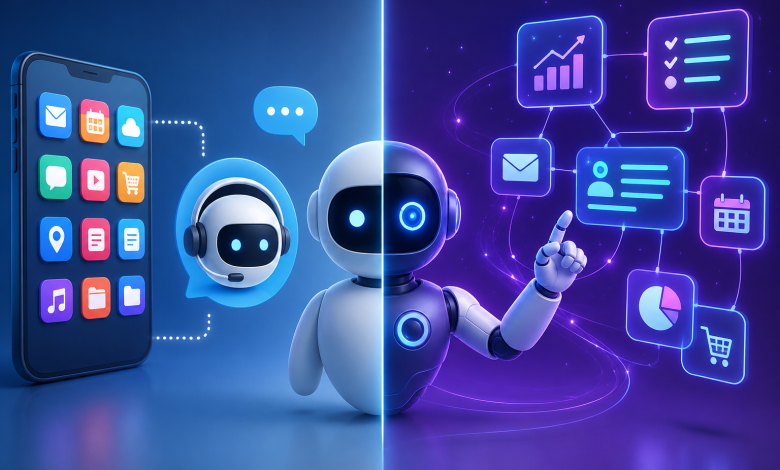
AI Agents vs Virtual Assistants
Here’s a simple comparison:
| Feature | AI Agents | Virtual Assistants |
|---|---|---|
| Decision Making | Advanced | Limited |
| Task Automation | Multi-step workflows | Basic commands |
| Learning Ability | Adaptive learning | Minimal learning |
| Business Usage | High | Moderate |
| Independence | Semi-autonomous | User-dependent |
| Productivity Level | Very High | Basic |
This shift is why many tech companies are investing billions into AI agent development.
Why Traditional Apps May Disappear
Traditional apps require users to manually switch between platforms for different tasks. For example:
- One app for email
- Another for project management
- Another for payments
- Another for scheduling
- Another for customer communication
AI agents can combine many of these tasks into a single intelligent workflow.
Imagine simply saying:
“Prepare my weekly business report, respond to urgent emails, schedule client meetings, and post today’s content.”
Instead of opening five different apps, one AI agent could complete everything automatically.
This convenience is one of the biggest reasons experts believe AI agents may eventually replace many traditional applications.
Industries Being Transformed by AI Agents
1. Business Automation
Companies are using AI agents to manage operations, customer support, sales tracking, and marketing campaigns more efficiently.
Small businesses especially benefit because they can automate tasks without hiring large teams.
2. Content Creation
AI agents now help creators:
- Write blog posts
- Generate video scripts
- Design social media captions
- Edit images
- Create marketing campaigns
This allows creators to produce more content faster than ever before.
3. Healthcare Technology
AI systems are helping doctors manage patient records, analyze medical data, and improve appointment scheduling.
Healthcare automation is expected to grow significantly throughout 2026.
4. Finance and Investing
AI agents can monitor markets, analyze trends, manage budgets, and provide personalized financial insights.
Many fintech companies are already integrating AI-powered automation into their services.
Benefits of AI Agents
Faster Productivity
AI agents can complete tasks within seconds that previously required hours of manual work.
Lower Costs
Businesses reduce operational costs by automating repetitive tasks.
Better Personalization
AI learns user behavior over time and provides smarter recommendations.
24/7 Availability
Unlike humans, AI agents can work continuously without breaks.
Challenges and Concerns
While AI agents offer major advantages, there are still important concerns.
Privacy Risks
AI systems often require access to personal information, emails, and work data.
Job Displacement
Some industries fear that automation may replace certain roles.
Overdependence on AI
Relying too heavily on automation may reduce human creativity and critical thinking.
Security Threats
Hackers may target AI-powered systems if proper cybersecurity measures are not used.
Major Tech Companies Investing in AI Agents
Several major technology companies are heavily focused on AI agent development, including:
- OpenAI
- Microsoft
- Meta
- Amazon
These companies believe AI agents could become the next major evolution of computing.
Will AI Agents Fully Replace Apps?
Probably not completely — at least not immediately.
Traditional apps will still exist for specialized tasks, gaming, entertainment, and professional software. However, AI agents may become the main layer that controls and connects those apps together.
Instead of users manually operating every application, AI agents may handle interactions behind the scenes.
This could completely change how people use technology in everyday life.
The Future of AI in 2026
Experts predict that AI agents will continue becoming more intelligent, personalized, and integrated into daily activities.
Possible future developments include:
- Fully autonomous digital assistants
- AI-powered business managers
- Personalized healthcare agents
- Smart financial planning systems
- Automated online businesses
- Advanced AI shopping assistants
The technology industry is moving toward systems that understand goals instead of waiting for commands.
Final Thoughts
The battle between AI agents and virtual assistants is shaping the future of technology in 2026. While virtual assistants introduced users to voice-based AI, modern AI agents are taking automation to an entirely new level.
As businesses and consumers demand faster, smarter, and more efficient digital experiences, AI agents may eventually replace many traditional apps and workflows.
Although challenges around privacy, security, and job automation remain important, one thing is clear:
AI agents are no longer just a futuristic concept — they are becoming a major part of modern life.